
Discover Bluum — The Bluum Collection
What do we actually want from longevity?
Ask someone why they care about aging and the answer is rarely a laboratory number. It is keeping up on a long walk, having energy for family, staying independent or continuing to do something they love.
More years and more healthy years are related goals, but they are not identical. That difference is a good place to begin any conversation about longevity — including the growing interest in peptides.
For readers curious about the molecules behind the discussion, Bluum Peptides offers a starting point for exploring laboratory research materials.
Aging is more than a visible change
We notice a new line or a slower morning because those changes are easy to see. Researchers look at a much wider picture: how cells respond to stress, maintain their components and communicate with their surroundings.
No single process tells the whole story. That is part of what makes aging research so interesting, and why a simple promise to “reverse aging” should lead to more questions rather than an immediate conclusion.
Why small molecules attract big attention
Peptides are short chains of amino acids. Some have signaling roles, which makes them useful subjects for scientists studying how biological processes are regulated.
That does not make every peptide an anti-aging intervention. Different compounds have different structures, purposes and evidence. A category is not a guarantee. A finding about one molecule cannot simply be transferred to another because both are called peptides.
Browsing Bluum’s research peptide collection makes those differences easier to see: each compound has its own specifications and research context.
The goal is not only more years. It is more life in those years.
A younger-looking number is not the whole story
Longevity headlines often revolve around a measurement. It might relate to a cellular process, a molecular marker or a way of estimating biological age. Measurements can be useful, but their meaning depends on how well they relate to outcomes that matter.
A change in a marker is not automatically a longer or healthier life. It is worth asking whether a study measured daily function, disease outcomes, lifespan or only a laboratory signal. The duration of the study and the effects it did not measure matter too.
This is not a reason to dismiss early research. It is a way to appreciate what a result actually contributes without asking it to prove more than it can.
For laboratory work, that means looking beyond a product name and checking the specifications and lot documentation alongside the scientific literature.
The telomere story, without the shortcut
Telomeres are protective structures at the ends of chromosomes. Their relationship with cell division has made them a familiar subject in aging research and a frequent feature of longevity headlines.
The tempting version of the story is that one measurable change must lead to more years. Biology is less straightforward. A mechanism can be scientifically important without establishing that changing it is safe or beneficial for people.
Epithalon is one compound appearing in this research conversation. Bluum lists it for laboratory work involving cellular signaling and telomerase-related processes. That classification does not show that its product extends human life. Qualified laboratory readers can find its specifications on Bluum’s Epithalon page.
Keep the goal connected to everyday life
It is easy for a longevity conversation to become a collection of products and measurements. A more personal starting point is to ask what you want to keep doing: moving comfortably, participating in your community or maintaining the routines that make life enjoyable.
Sleep, movement, food and appropriate preventive care belong in that conversation with a qualified clinician. An experimental compound is not a substitute for understanding your own health and priorities. The goal is a life you can participate in, not just a number you can improve.
Curiosity works best with perspective
There is plenty to find fascinating in peptide and aging research. You do not need to turn every promising mechanism into a personal intervention to take that science seriously.
When a new claim catches your attention, ask: Was this studied in cells, animals or people? What outcome was measured? How were risks assessed? Keep those distinctions in view and the longevity conversation becomes both more interesting and more useful.
To explore the compounds behind these research questions, visit the Bluum collection.
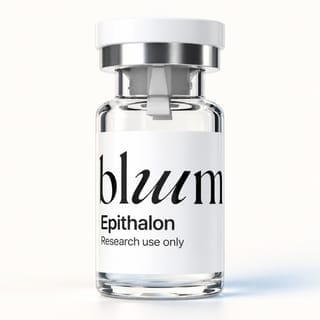
Epithalon · From $45 10 mg / 40 mg · For laboratory research only
Research context
Products are for laboratory research only, not human or animal use. Prices shown in the reviewed draft may change; verify current options on the product page.